

Caring for the People Who Drive Change: Mental Health Resources
Mental health is a topic that, in recent years, has gained importance, and the social innovation sector has been addressing it deeply. This should not surprise us, since despite so many barriers that have been broken down, reports from the World Health Organization show how almost one billion people around the world are living with a mental health condition, while research suggests that one in two people will experience mental health problems at some point in their lives.
Behind these numbers are social innovators who, day after day, face situations that put their well-being to the test due to the pressure of creating impact. And for this, there is Catalyst Now, to create a space where social innovators find a key place in systemic change and we co-create healthier communities, more humane work environments, and more sustainable ways of living and leading.
Every May, Mental Health Awareness Month invites us to pause and reflect on our well-being. How do we build systems of change that also care for the people who make them up? That is why in this blog, we want to share the various resources and tools we have created over the years to cultivate the mental and physical well-being of our community.
“I come to work to help others, but sometimes I feel like I’m the one who needs help.” – Rosa, Building Peace through Mental Health: 4 Insights from the SanaMente Program
Innovating in Mental Health
Our Mental Health Collaboration is one of Catalyst Now’s first collaborations and brings together more than 130 global leaders, organisations, and individuals across continents and cultures. Through professional exchanges between practitioners in the field, the collaboration addresses important areas such as anti-stigma, community mental health, suicide prevention, maternal and child mental health, and fundraising for mental health programming, topics that you can explore further in the Mental Health Collaboration Sessions.
In addition to these collaboration series, over the years we have offered learning experiences such as: Reimagining Mental Health as a Driver for Impact, Before Impact: Teaching Inner Development and Wellbeing, and Deep Listening with Emily Kasriel
Amplifying Knowledge
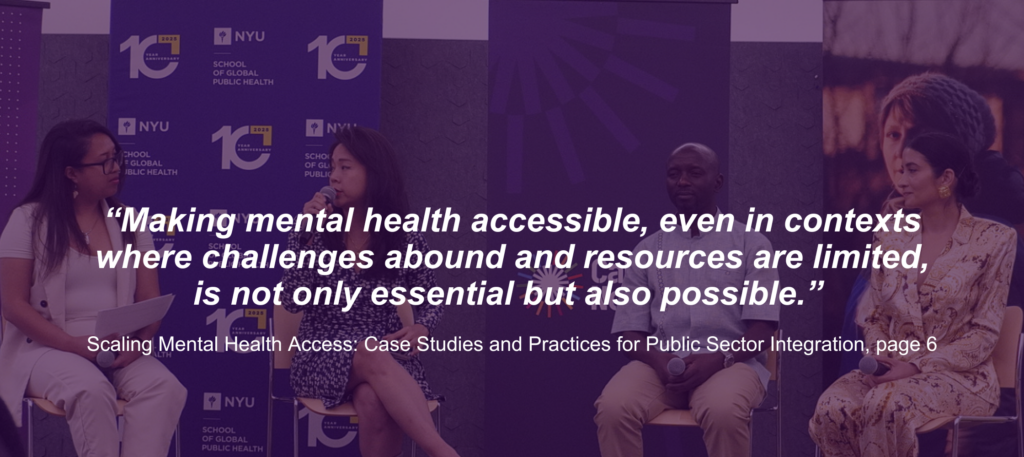
However, our work on this topic is not limited to webinars and learning series; we also have articles and research, such as the report Scaling Mental Health Access: Case Studies and Practices for Public Sector Integration. This report, translated into five languages, reflects on the importance of mental health becoming part of everyday life, transcending clinical spaces into schools, community spaces, and justice settings.
Alongside this work, as part of our Igniting Systems Change platform, our article repository, we have Combining Present and Future: Combining Present and Future: A Framework for Sustainable Wellbeing, which offers a thoughtful lens on what it means to care for ourselves while building the future we envision. Building Peace through Mental Health: 4 Insights from the SanaMente Program explores how in communities marked by conflict and crisis, the effects often linger long after the moment has passed, and how emotional support and community care can help people slowly rebuild trust, resilience, and a sense of safety.
Resources That Transcend
These conversations, with the collaborative spirit of Catalyst Now, where collaboration goes beyond our channels and platforms, include the podcast Mind the Gap, launched by our members and co-chairs of the Mental Health Collaboration, Chris Underhill and Christie Civetta. Through anecdotes, they take us on a journey recounting what it truly takes for mental health support to be accessible, sustainable, and human, especially in places where access to care is often more difficult.
That same sense of Insight: A bank of wisdom for social innovators, created by theElders Council for Social Entrepreneurs. It brings together reflections and practical wisdom from across the social impact ecosystem; the platform offers thoughtful perspectives for people navigating the complexities, questions, and everyday realities that generating change so often entails.
Well-being and mental health do not have a predetermined formula, but they are a reminder that supporting people is just as important as supporting the work they do. We invite you to join us in the sessions we have prepared for you, and additionally, in partnership with The Wellbeing Project, we are launching the Changemaker Well-being Survey (available in 12 languages and taking only 10 minutes), to gather fundamental data to strengthen our sector.
